
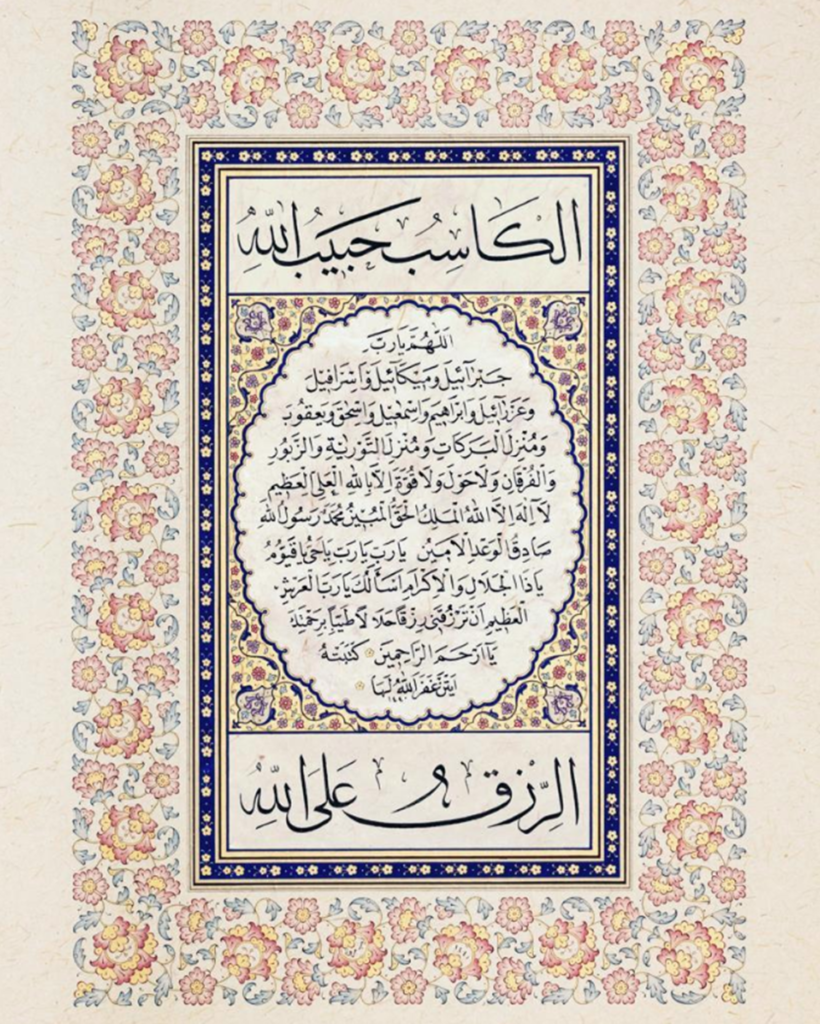
The word murakka‘, which means “patched” in Arabic, originates from the word murakkaa in the sense of album, and it passed from Persian to Turkish as murakka‘. Its plural is murakkaât. The stanzas intended to be included in a murakka are glued to a cardboard prepared according to the stretching (aş.bk.) method and decorated around it, then they are cut to the same size, brought back to back and attached to each other with a thin leather or fabric strip on three sides. These glued strips also prevent the edges of the stanzas from fraying. Then, this double stanza is connected to another double stanza from the bottom with another leather or fabric strip. When all the stanzas are thus brought together, the murakka‘ is bound in the classical style and a cover is placed on it. This type of murakka‘ is known as “plain murakka‘, book murakka‘” or simply murakka‘. If two back-to-back continents are connected only by the throat and this is repeated in the others, it is possible to open and see all the continents at the same time and then fold them in a zigzag manner. This type, which is connected to its cover only from the first continent, is called “bellows murakka‘”.
Murakkas, the oldest examples of which are encountered at the end of the 15th century, were first prepared in the form of books. In this way, beautiful writings, as well as different branches of art such as miniature, katı‘, illumination from different periods, were brought together and preserved from wear for a long time. Murakkas, which are formed by the combination of a small or large number of continents according to their content, were sometimes made as miniature and illumination albums, but they were mostly used for calligraphy.
If the verses of the murakkas in a sequential page layout, especially as curriculum meshki (elifbâ) showing single letters and the joining of two letters, or murekkebat meshki (qasidas, prayers, verses and hadiths) teaching the composition of words and sentences, were written specifically for such a meshk murakka, the signature of the calligrapher is only found in the last verse. In old murakkas, the most common calligraphy types are aklâm-ı sitteye and ta‘lîk. It has been customary to put one of the types written with a fine pen (nesih, reyhânî, rikā‘) under a single line written in one of the major types of aklâm-ı sitte, sülüs, muhakkak, tevkī‘ scripts. In murakka‘ verses written in a row, the text of each type of script continues separately. In this type of murakka, which is called “sequential murakka‘”, if the phrases of the stanzas are left unfinished, they are completed in the continuation stanzas. On the other hand, in murakka‘s prepared later by bringing together independent stanzas and called “collective murakka‘”, it is also encountered that stanzas, each of which is independent and signed by its calligrapher separately, or even written by various calligraphers, are brought together.
In murakka‘s where various stanzas are collected, if the size of one stanza does not match the other, only the inner border of the two opposite edges is kept wider or a separate intermediate border called a wedge is added on both sides to ensure harmony of size. There are also murakka‘ stanzas prepared without observing this.
Stretching murakka‘ is also applied as follows: In old times when ready-made cardboards were not available, sturdy papers of different sizes were moistened and glued together like patches on a smooth murakka‘ board, and the papers were stuck to this board on all four sides with their wide margins. When dry, these stretched papers, called “mukavva” (reinforced), were glued with continents and decorated around them, then cut with the help of a ruler and released. Murakkas are the richest works of Islamic arts, processed with fine taste in terms of color, pattern, miniature and calligraphy. Before the development of celî script, the most beautiful examples of calligraphy were mostly seen in manuscripts and murakkas. There are very valuable murakka examples in museums, libraries and private collections, especially in the Topkapı Palace Museum, Istanbul University Library and the Turkish and Islamic Arts Museum. Due to the increasing interest in Islamic arts in Europe and America, research was carried out in the field of Indian, Iranian and Ottoman murakkas along with facsimiles.


