
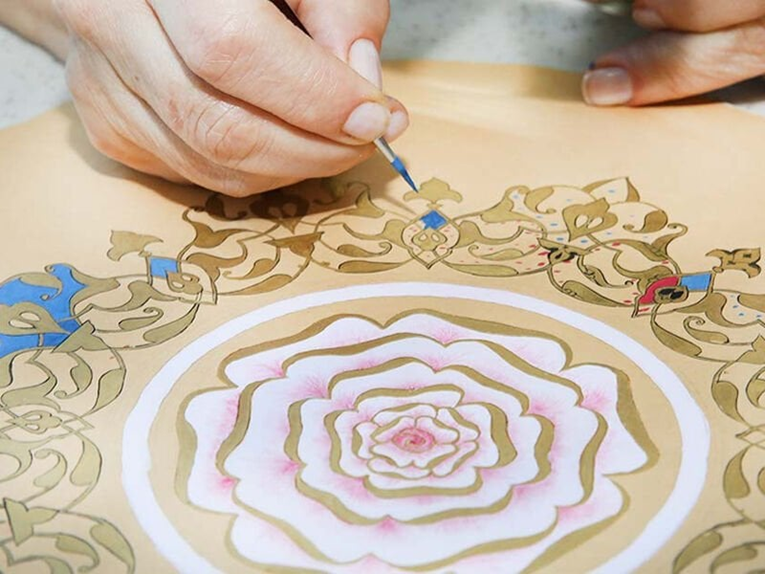
Illumination, one of the Turkish decorative arts, literally means to decorate with gold. It is the work of decorating manuscripts such as books and tablets using 18 or 22 carat crushed gold and various colors. Illumination is the whole of the works that emerge as a result of work done with patience, pleasure and elegance. In Arabic, tezhip means “golding”, “gilding”, “decoration”. It is the name given to all kinds of decorations made with gold dust and paint on the pages of manuscripts, calligraphy plates, murakkas, and even the upper parts of tughras. The word tezhip is not only used for decorations made with gold, but is also used for decorations made with earthen paints. Illumination made using only gold is called “halkari”. The artist who makes the illumination is called şehhip or şehhibe, and the illuminated work is called şehheb. People who want to deal with this unique art take illumination lessons or continue with illumination courses. Illumination beginner courses are usually opened by municipalities or foundations. Now, if you wish, let’s move on to our article where we answer questions such as what is an illumination lesson, where to apply to take illumination lessons, is there an illumination course in Izmir?
What is Illumination?
Illumination, which has always had great importance among the book arts, is known as an art that reveals the writing and increases the value of the work, together with the art of calligraphy in Turkish-Islamic book art.
Illumination is an extremely delicate art of book decoration. It means to gild in Arabic and is derived from the Arabic word zehep (gold). Naturally, the main material used in illumination is gold. In addition to gold, various colors obtained from earthen paints are also used in illumination art. In this art, where fine brush technique is very important, the writings on the manuscripts are decorated and dressed in the most beautiful way. Some manuscripts may have only a few illuminated parts, while there are also works that are mostly or even completely illuminated.
Illumination Sections
Illuminations are called by different names depending on the way they are made and where they are made. Illumination done only with gold and on the page edges is called “halkari”. The decoration usually done on the page edges, sometimes on the entire page, and made by sprinkling gold dust is called “zerefşan”.
Illumination can be seen in almost every section of the book in manuscripts. However, we can list the most common sections as follows:
- Hatime illumination
- Page edge illumination
- Blank page illumination
- Intermediate space and seat illumination
- Border, Ulema, Zencirek, Kenar Suyu
- Rose illumination
- Surah beginning illumination
- Vakfiye illumination
- Serlevha illumination
- Index illumination
- Zahriye illumination
What is Muzehhip, Muzehhibe?
The people who make illumination (artists) are called ‘muster’. Muzehhibe is defined as an ornament artist. It can be described as an artist who especially decorates different sections of manuscripts. Although it is considered a special profession, it should be said that there are artists who are experts in a branch of art.
What is Illumination Course?
Those who are devoted to the art of illumination and want to receive training in this subject can find this opportunity in many places, both online and as private courses. Especially municipalities and foundations provide satisfactory training in this traditional art branch. Everyone who is devoted to the art of illumination and wants to relax their soul with this unique art of ornamentation should receive illumination training. If you want to learn what illumination art is, what materials it is performed with and how it is done, taking an illumination course is just for you.
What is Taught in Illumination Courses?
When you go to an illumination course or take an illumination course, the aim is for you to gain the following gains: You will internalize the classical infrastructure in the art of illumination. You will interpret the works in accordance with the original; You will create original works using your knowledge of history, patterns and application. Ultimately, you will become an illuminator who produces his own original works using the right materials. In addition, you will enjoy the pleasure and peace that comes from learning and performing the art of illumination. You will also have made a great contribution to your personal development. It is also a plus to ensure that a traditional Turkish handicraft continues and spreads.
A person who learns the art of illumination can use this art in many areas by using his creativity. He can continue this as a hobby or evaluate the works he produces as he wishes. When all these are taken into consideration, learning the art of illumination will provide you with much more in addition to your personal development.
How Long Does an Illumination Course Last?
There is no officially determined duration for illumination courses. Illumination courses are given for periods ranging from 3 to 6 months, depending on the program, curriculum and content prepared by the institution providing the education. However, as in all traditional arts, education and learning never ends for illumination, it is a lifelong process. Just like in the art of calligraphy, continuity and continuity are important in the art of illumination.
If a person practices this art continuously without taking a break, her experience and the quality of her works will increase.


