Click image to view full screen

Aizen Myōō
✓ Authenticity guarantee · ✓ Specialist condition report · ✓ Insured worldwide shipping · ✓ Private-room viewing
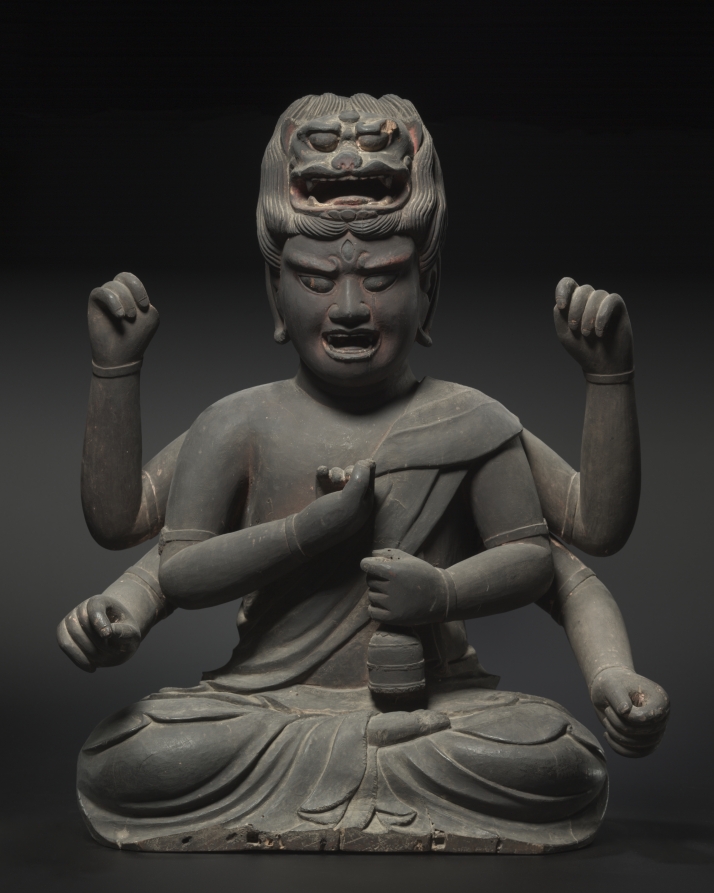
The Buddhist deity Aizen Myōō channels carnal desire into a lust for spiritual enlightenment. In its principal right arm, this figure once held a <em>vajra</em>, a symbolic weapon used to cut through illusion, while its main left arm still grasps the vajra bell rung to bring one to awareness. The lion’s head in Aizen’s hair holds its mouth open to devour thoughts and desires. Holes along the front of the legs show where the sculpture’s base would have been attached.
| Artist / Maker | Japan, Kamakura period (1185–1333) |
|---|---|
| Date | early 1300s |
| Culture / Origin | Japan, Kamakura period (1185–1333) |
| Medium | Wood with black lacquer and red pigments |
| Dimensions | Overall: 75 x 59 x 35 cm (29 1/2 x 23 1/4 x 13 3/4 in.) |
| Department | Japanese Art |
| Type | Sculpture |
About the Artist
Provenance & Source
Image & data: Cleveland Museum of Art, CC0 / Public Domain.
Condition
A detailed condition report and high-resolution photography are available from our specialists in advance of the sale.
Shipping & Collection
Fine-art shipping with climate control and full insurance to over 120 countries; collection by appointment.
Buying at Matchless Pieces
Register, verify your identity, and bid online or in a private room. Buyer’s premium and taxes are shown before you confirm.
You May Also Like

Japan, Kamakura period (1185–1333)
Scroll of Miscellaneous Notes written on a Calendar by Priest Seigen (verso)
Japan, Kamakura period (1185–1333)
Scroll of Miscellaneous Notes written on a Calendar by Priest Seigen (recto)
Japan, Kamakura period (1185–1333)
Amida (base)