Click image to view full screen

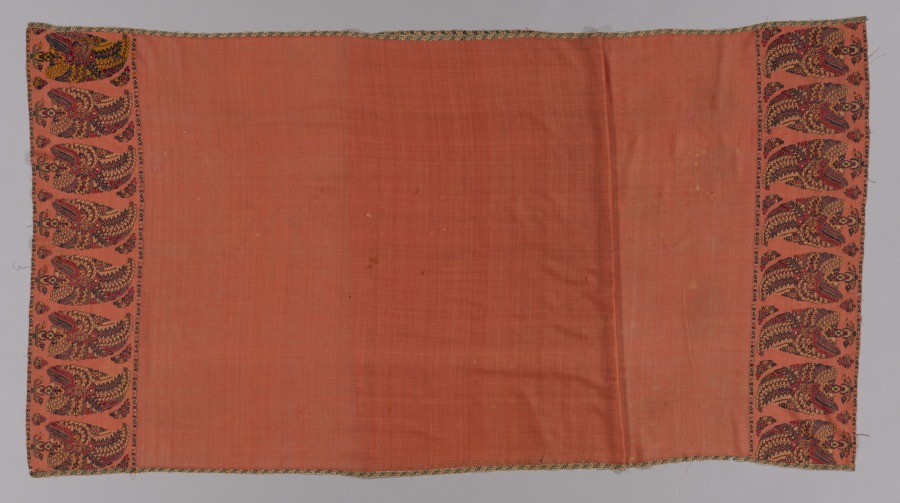
Apricot Long Shawl
✓ Authenticity guarantee · ✓ Specialist condition report · ✓ Insured worldwide shipping · ✓ Private-room viewing
Artistic styles evolved with increasingly elaborate mosaic-like decoration during the 1800s to meet an insatiable European demand. Early shawls had plain fields with isolated plants in the end panels, which led to decorated side borders and vases of blossoming stems. Such flora was replaced by colorful, dense blossoms forming cone-shaped <em>botehs</em>, or paisleys, on trays. To this was added a gallery of small botehs and angular floral vines around a rich blue field with single botehs in the corners. Lightweight, supple, warm, and colorful, Kashmir shawls had no equal. Fine, soft goat-hair wool was woven in a 2/2 twill tapestry weave—the equivalent of painting with colored weft threads. Imitations woven in Paisley, Scotland, prompted the popular term <em>paisley</em>.
| Artist / Maker | India, Kashmir, Afghan period |
|---|---|
| Date | 1785–1800 |
| Culture / Origin | India, Kashmir, Afghan period |
| Medium | 2/2 twill tapestry weave, double interlocked; wool |
| Dimensions | Overall: 325 x 104.1 cm (127 15/16 x 41 in.) |
| Department | Textiles |
| Type | Textile |
About the Artist
Provenance & Source
Image & data: Cleveland Museum of Art, CC0 / Public Domain.
Condition
A detailed condition report and high-resolution photography are available from our specialists in advance of the sale.
Shipping & Collection
Fine-art shipping with climate control and full insurance to over 120 countries; collection by appointment.
Buying at Matchless Pieces
Register, verify your identity, and bid online or in a private room. Buyer’s premium and taxes are shown before you confirm.