Click image to view full screen

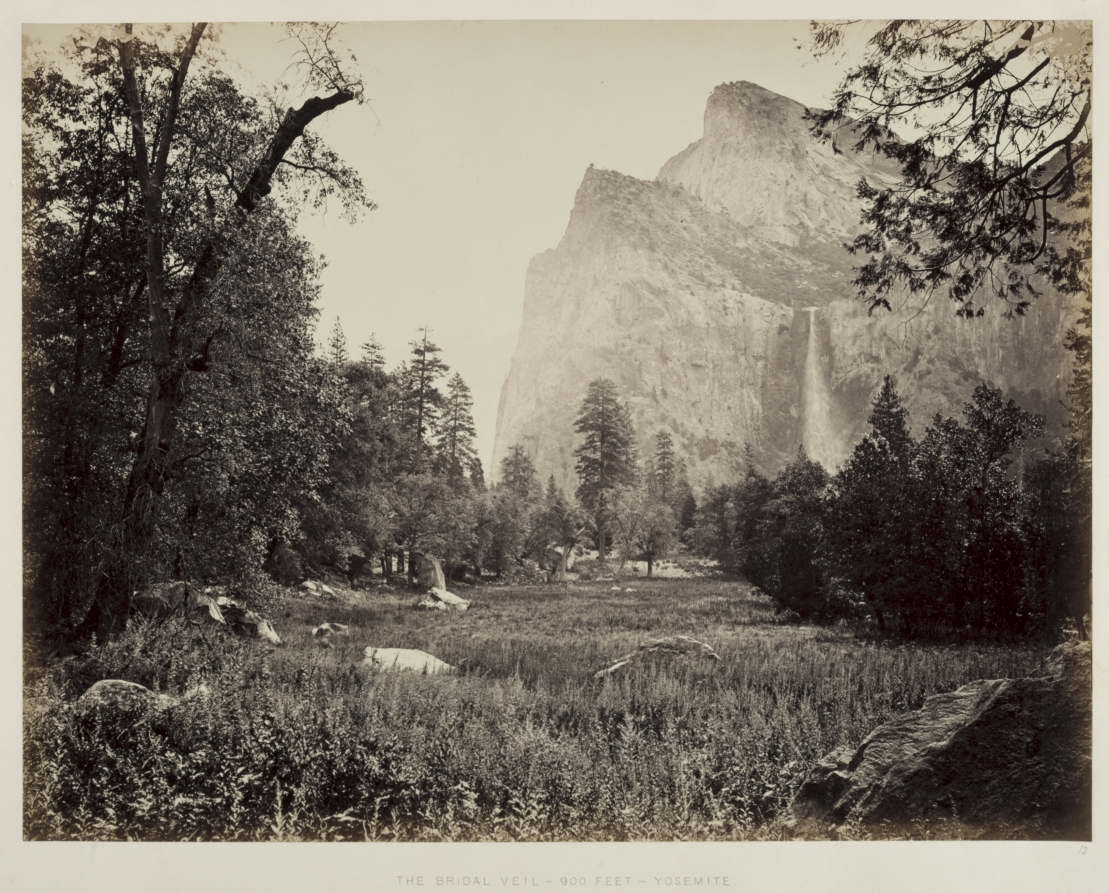
Bridal Veil, Yosemite
✓ Authenticity guarantee · ✓ Specialist condition report · ✓ Insured worldwide shipping · ✓ Private-room viewing
The grand scale of the American West was difficult to convey in early photographs, which were intimately scaled objects meant for the hand and the album. Starting in the late 1850s, a handful of photographers shooting landscapes and historical settings began producing “mammoth” prints, including the San Francisco-based Carleton E. Watkins. The seemingly gargantuan scale of these prints allowed a new, immersive relationship between the viewer and the image, enhancing that “you are there” feeling.
| Artist / Maker | Carleton E. Watkins |
|---|---|
| Date | 1865–66 |
| Culture / Origin | America |
| Medium | albumen print from wet collodion negative |
| Dimensions | Image: 40.1 x 52.4 cm (15 13/16 x 20 5/8 in.); Matted: 61 x 76.2 cm (24 x 30 in.) |
| Department | Photography |
| Type | Photograph |
About the Artist
Carleton E. Watkins American, 1829-1916 Born in Oneonta, New York, Carleton Watkins traveled west to California in the early 1850s, shortly after the gold rush. He learned photography in 1854 from Robert Vance, one of the earliest and best of San Francisco's daguerreotypists. Vance's landscape photography, unusually skilled for the time, may have influenced Watkins's work. Watkins was among the first photographers in the Yosemite valley, shooting there in 1861, and his mammoth-plate landscape photographs of the area are believed… Full biography →
Provenance & Source
Image & data: Cleveland Museum of Art, CC0 / Public Domain.
Condition
A detailed condition report and high-resolution photography are available from our specialists in advance of the sale.
Shipping & Collection
Fine-art shipping with climate control and full insurance to over 120 countries; collection by appointment.
Buying at Matchless Pieces
Register, verify your identity, and bid online or in a private room. Buyer’s premium and taxes are shown before you confirm.


