Collecting Iznik ceramics offers a direct connection to the artistic confidence of the Ottoman court at its height. Produced in the town of Iznik in northwestern Anatolia, these vessels and tiles combine technical mastery with designs that shaped Ottoman taste for generations. For the collector, understanding their history, phases and condition is the foundation of every sound acquisition.
A Brief History of Iznik Pottery
Iznik potters were active from the late fifteenth century, working on a fritware body that imitated the whiteness of Chinese porcelain. Close ties with the imperial design workshop, the nakkaşhane, in Istanbul meant that patterns used in manuscripts, textiles and metalwork often appeared on ceramics too.
Imperial building projects of the sixteenth century, including mosques associated with the architect Sinan, created enormous demand for tiles. As patronage weakened in the seventeenth century, quality declined, and production effectively ended by the early eighteenth century.
Recognising the Stylistic Phases
Scholars commonly describe Iznik production in broad phases, each with a characteristic palette and vocabulary:
- Blue-and-white: early wares inspired by Chinese porcelain and court arabesque designs.
- Golden Horn style: fine spiralling scrolls, once wrongly associated with a district of Istanbul.
- Damascus style: a softer palette with sage green and manganese purple.
- Rhodian style: the mature phase, with tulips, carnations, saz leaves and the famous raised bole red.
These labels are conventions rather than strict chronological boundaries, and overlap is common. Their value lies in helping collectors read a piece against established reference material.
Condition and Authenticity
Most Iznik that survives has seen use, so wear, glaze losses and restoration are usual. A sixteenth-century dish with old restoration may still be highly desirable, but the extent of any intervention should be clearly disclosed. Examine pieces under good raking light and, where appropriate, ultraviolet light, which can reveal overpainting and fills.
Nineteenth-century European workshops produced skilful Iznik-style wares. Differences in body, glaze, the tone of the red and the handling of the drawing often distinguish them. Provenance, published references and expert opinion remain the collector’s best safeguards.
Building an Iznik Collection
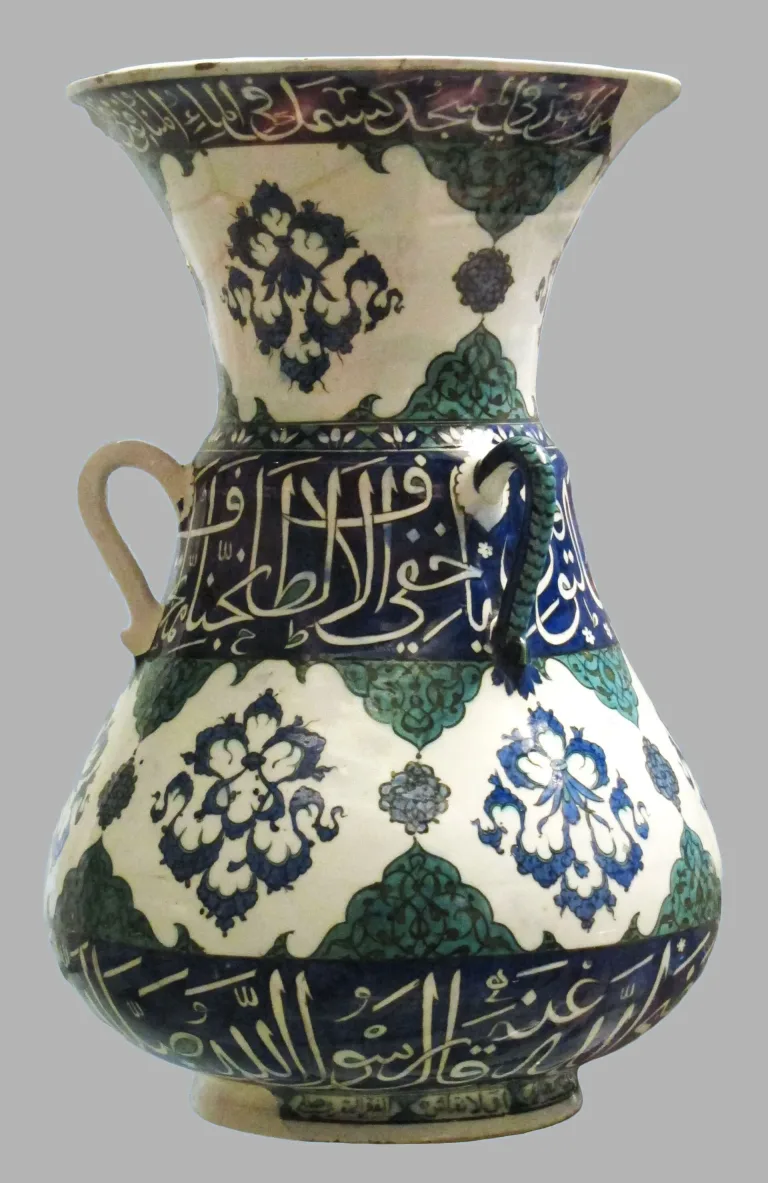
Start by handling as much material as possible in museums, exhibitions and saleroom viewings. Many collectors begin with tiles or fragments, which can be beautiful and instructive, before moving on to dishes, jugs or rarer forms such as mosque lamps.
Ask for detailed condition reports and documentation, and look for coherent provenance. Our ceramics and glass category and wider Ottoman art pages offer context, while our specialists can be reached through the contact page.
For display, keep ceramics on stable shelving away from vibration and sudden temperature changes, and consult a professional conservator before cleaning or treating any restored piece.
Reading the Back and Foot
Experienced collectors always turn a dish over. The underside of a sixteenth-century Iznik dish typically carries simple decoration, such as alternating rosettes and tulip sprays or small floral motifs, painted with the same fluency as the front. The foot ring, glaze pooling and any kiln grit offer further clues about manufacture.
Look, too, at how the glaze behaves. Period glazes often show fine crazing or slight bubbling, while the raised bole red of the mature phase sits in low relief on the surface. None of these features is conclusive on its own, but together they help build an informed judgement. Comparing pieces side by side at auction viewings is one of the most effective ways to train the eye, and specialist literature on Iznik provides many illustrated examples for reference.
Frequently Asked Questions
What is Iznik pottery made of?
Iznik wares are fritware, or stonepaste: a body composed largely of ground quartz mixed with glass frit and a small amount of clay, covered with a white slip and a clear lead-alkaline glaze.
When was Iznik pottery at its height?
Production flourished from the late fifteenth century and reached its celebrated peak in the second half of the sixteenth century, when bole red joined the palette. Quality declined during the seventeenth century.
Are later Iznik-style ceramics collectable?
Yes. Kütahya wares and nineteenth-century European revival pieces, such as those by Samson or Cantagalli, have their own markets, but they should be described and valued as what they are, not as sixteenth-century Iznik.