Click image to view full screen

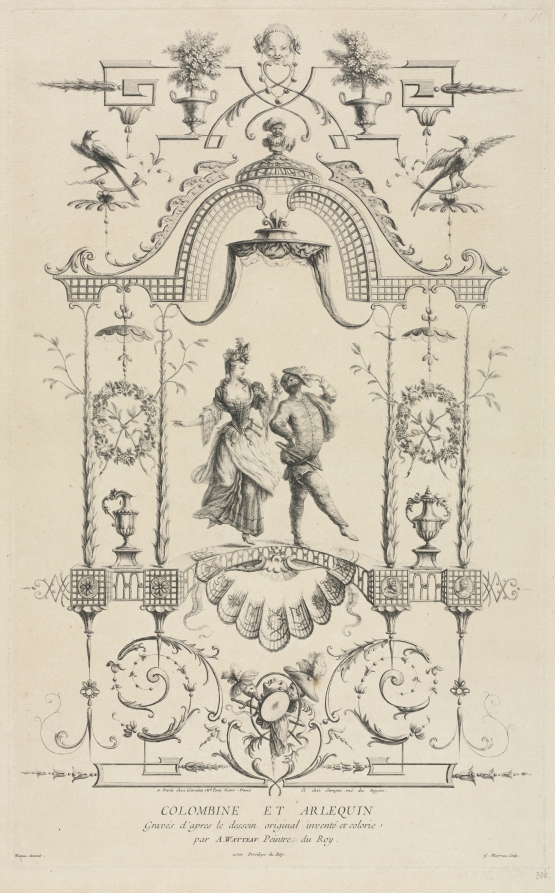
Columbine and Harlequin
✓ Authenticity guarantee · ✓ Specialist condition report · ✓ Insured worldwide shipping · ✓ Private-room viewing
Arabesques (decorations with curves and tendrils inspired by plant forms) were in vogue in 18th-century France. Watteau (1684-1721) produced arabesques for the ornamentation of walls, paneling, furniture, and ceilings. He depicted popular motifs, such as the elegant courtship in an idyllic outdoor setting pictured in The Gallant, shown nearby, or as in Columbine and Harlequin, two characters from productions of the Commedia dell'arte, an Italian comic theater. Watteau launched a trend for the exotic scenes found on imported Chinese porcelains and lacquer ware about 1707. The parasol in The Gallant, and the Asian face that smiles down from the top of Columbine and Harlequin, are examples of chinoiserie, the playful imitation of Chinese art.
| Artist / Maker | Jean Moyreau |
|---|---|
| Date | c. 1729 |
| Culture / Origin | France |
| Medium | etching |
| Dimensions | Platemark: 51.6 x 32 cm (20 5/16 x 12 5/8 in.) |
| Department | Prints |
| Type |
About the Artist
Jean Moyreau (French, 1690–1762) Full biography →
Provenance & Source
Image & data: Cleveland Museum of Art, CC0 / Public Domain.
Condition
A detailed condition report and high-resolution photography are available from our specialists in advance of the sale.
Shipping & Collection
Fine-art shipping with climate control and full insurance to over 120 countries; collection by appointment.
Buying at Matchless Pieces
Register, verify your identity, and bid online or in a private room. Buyer’s premium and taxes are shown before you confirm.