Click image to view full screen

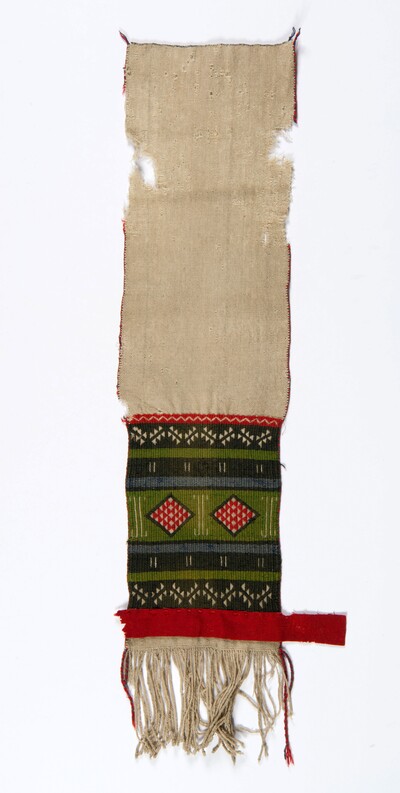
Dance belt
✓ Authenticity guarantee · ✓ Specialist condition report · ✓ Insured worldwide shipping · ✓ Private-room viewing
362-187Hopi woven belt, faja (TK); wool; l. 239 cm., w. 9 cm.; ca. 1880.Such belts were usually used by women to secure their dress, but on ceremonial occasions men adopted these for their costume (Bartlett 1949:6; Fox 1978:52). Marian Rodee (1992) noted of this rather damaged specimen: "Belt with wool warp and weft, a rather unusual specimen as there is no cotton present. The weft contains brown wool yarn, and handspun indigo wool laid in pairs in the center. The edges are red and green two-ply split from four-ply. Although the Navajo-style belt was woven by Navajos and Hopis, the Hopi-style belt was only made at Hopi and possibly other Pueblos, but not made or worn by Navajos. Their manufacture and design differ in a number of respects. Their origin has not yet been exactly established, but the oldest fragments have been recovered from Salado sites in Tonto National Monument (McLeish 1940; Kent 1983:85-89).Hopi textilesDuring the Pueblo I period (900-1100), the Anasazi ancestors of the Hopis, Zunis, and Rio Grande Pueblos began cultivating a native species of cotton, Gossypium hopi, that was well adapted to the altitude and semi-arid climate of the Colorado Plateau. It was use
| Artist / Maker | Anonymous, miniature painting |
|---|---|
| Culture / Origin | miniature painting, Netherlands |
| Department | miniature painting |
About the Artist
Provenance & Source
Image & data: National Museum of World Cultures Foundation via Europeana · Licence: CC0.
Condition
A detailed condition report and high-resolution photography are available from our specialists in advance of the sale.
Shipping & Collection
Fine-art shipping with climate control and full insurance to over 120 countries; collection by appointment.
Buying at Matchless Pieces
Register, verify your identity, and bid online or in a private room. Buyer’s premium and taxes are shown before you confirm.