Click image to view full screen

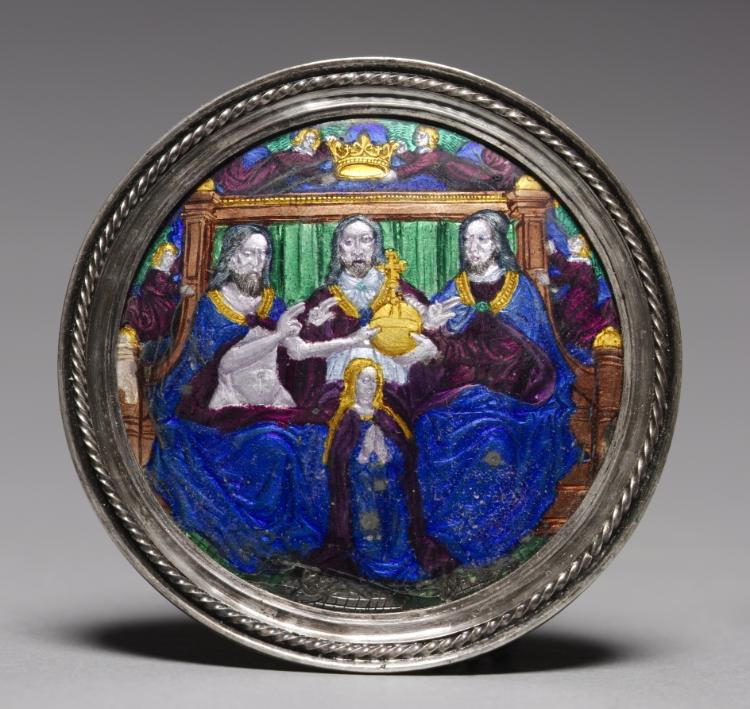
Medallion: Coronation of the Virgin
✓ Authenticity guarantee · ✓ Specialist condition report · ✓ Insured worldwide shipping · ✓ Private-room viewing
The word enamel derives from the Old French <em>esmail</em> and the Old High German <em>smelzen</em>, meaning "to smelt." This is the most crucial process in the making of enamel. To prepare enamel, the constituents of glass (flint, or sand, as well as red lead, and soda or potash) are heated together to form a clear flux. To this a coloring agent (usually a metallic oxide) is added: copper for green, cobalt for blue, iron for red or brown. The enamel is then allowed to cool and solidify in slabs. Before use, each color is separately ground into a fine powder, placed on a prepared metal surface, and fired in a kiln. When cool, the surface is polished to remove any imperfections and add brilliance to the colors. The difference between the various enameling techniques lies chiefly in the methods used to prepare the metal surface for the enamel.
| Artist / Maker | France |
|---|---|
| Date | late 1400s |
| Culture / Origin | France |
| Medium | basse-taille enamel on silver |
| Dimensions | Framed: 7.7 cm (3 1/16 in.); Unframed: 6.1 cm (2 3/8 in.) |
| Department | Medieval Art |
| Type | Enamel |
About the Artist
Provenance & Source
Image & data: Cleveland Museum of Art, CC0 / Public Domain.
Condition
A detailed condition report and high-resolution photography are available from our specialists in advance of the sale.
Shipping & Collection
Fine-art shipping with climate control and full insurance to over 120 countries; collection by appointment.
Buying at Matchless Pieces
Register, verify your identity, and bid online or in a private room. Buyer’s premium and taxes are shown before you confirm.


