Click image to view full screen

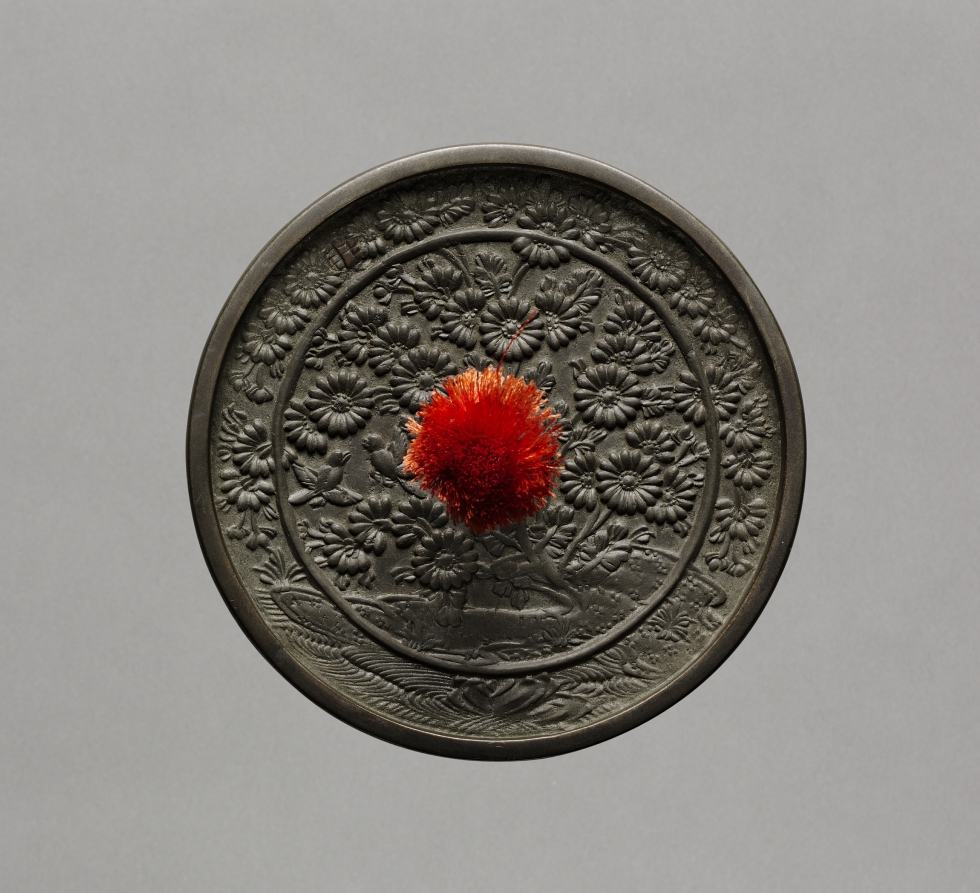
Mirror
✓ Authenticity guarantee · ✓ Specialist condition report · ✓ Insured worldwide shipping · ✓ Private-room viewing
The Japanese used chrysanthemums as decorative elements on mirrors. In the Heian period, a chrysanthemum with cranes or long-tailed birds was a common motif. Later, in the Kamakura and Muromachi periods, chrysanthemum designs were divided into three patterns with different symbolic associations: Chrysanthemum with Cranes represented longevity; Water Flowing suggested longevity as well as the Noh drama <em>Kikujido</em>, or Chrysanthemum Boy; and East Fence alluded to the poem "Drinking Wine" by Tao Yuanming (365–427 CE). Here, the mirror featuring Buddhist iconography (<em>kyojo</em>) and a chrysanthemum design on the back shows that the flower was also appreciated in the context of Buddhism in the Kamakura period.
| Artist / Maker | Japan, Kamakura period (1185–1333) |
|---|---|
| Date | 1200s–1300s |
| Culture / Origin | Japan, Kamakura period (1185–1333) |
| Medium | bronze |
| Dimensions | Diameter: 10.7 cm (4 3/16 in.) |
| Department | Japanese Art |
| Type | Metalwork |
About the Artist
Provenance & Source
Image & data: Cleveland Museum of Art, CC0 / Public Domain.
Condition
A detailed condition report and high-resolution photography are available from our specialists in advance of the sale.
Shipping & Collection
Fine-art shipping with climate control and full insurance to over 120 countries; collection by appointment.
Buying at Matchless Pieces
Register, verify your identity, and bid online or in a private room. Buyer’s premium and taxes are shown before you confirm.
You May Also Like

Japan, Kamakura period (1185–1333)
Scroll of Miscellaneous Notes written on a Calendar by Priest Seigen (verso)
Japan, Kamakura period (1185–1333)
Scroll of Miscellaneous Notes written on a Calendar by Priest Seigen (recto)
Japan, Kamakura period (1185–1333)
Amida (base)