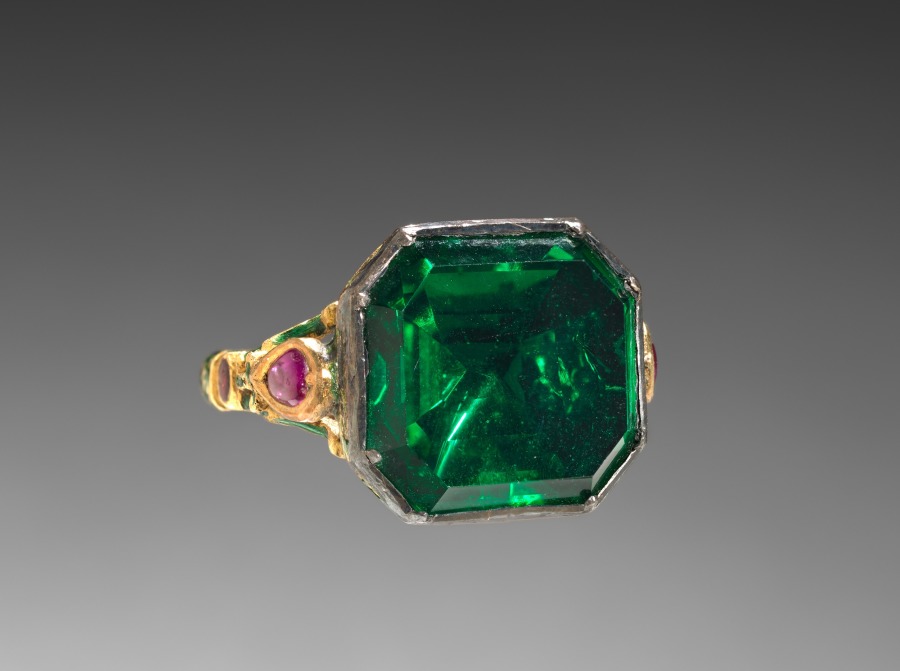
Click image to view full screen

Ring
✓ Authenticity guarantee · ✓ Specialist condition report · ✓ Insured worldwide shipping · ✓ Private-room viewing
From the beginning of Emperor Jahangir’s reign in 1605, Mughal court culture became increasingly focused on jewels. Gems were the source of much of the court’s wealth, and the diamond mines of the southern regions of the Deccan provided financial incentives for Mughal conquest of those territories. According to European diplomatic accounts, gems were the preferred gift to the emperor. Rubies, like those set into this ring, were imported from Myanmar and Central Asia and were the preferred gems of Mughal royalty, alongside emeralds.
| Artist / Maker | India, Mughal Dynasty (1526–1756) |
|---|---|
| Date | 1700s |
| Culture / Origin | India, Mughal Dynasty (1526–1756) |
| Medium | Gold, colored glass, rubies, and enamel |
| Dimensions | Diameter: 2.6 cm (1 in.) |
| Department | Indian and Southeast Asian Art |
| Type | Jewelry |
About the Artist
Provenance & Source
Image & data: Cleveland Museum of Art, CC0 / Public Domain.
Condition
A detailed condition report and high-resolution photography are available from our specialists in advance of the sale.
Shipping & Collection
Fine-art shipping with climate control and full insurance to over 120 countries; collection by appointment.
Buying at Matchless Pieces
Register, verify your identity, and bid online or in a private room. Buyer’s premium and taxes are shown before you confirm.
You May Also Like

India, Mughal Dynasty (1526–1756)
Page with Two Columns of Persian Writing
India, Mughal Dynasty (1526–1756)
Page with Panel with Two Columns of Persian Writing
India, Mughal Dynasty (1526–1756)
Page with Two Columns of Persian Writing