Click image to view full screen

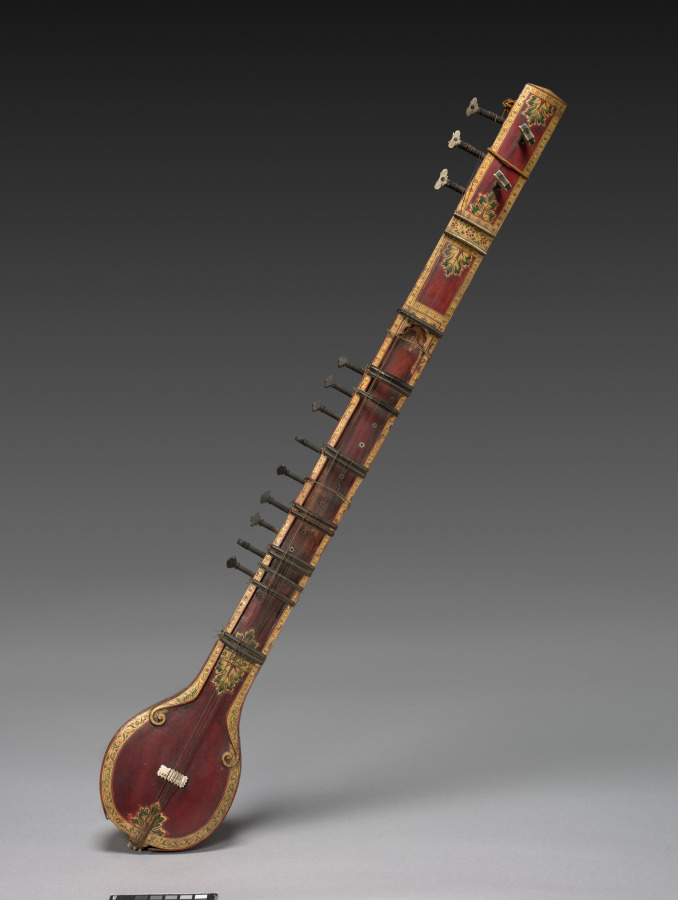
Sitar
✓ Authenticity guarantee · ✓ Specialist condition report · ✓ Insured worldwide shipping · ✓ Private-room viewing
The stringed instrument known as the sitar usually provided the central sound for the musical performances that were a constant feature of court life in India. The sitar could then be accompanied by percussion, voice, and other supporting instruments. In Raja Deen Dayal’s photograph <em>Maharaja of Rewa in Prayer </em>(<a href="http://www.clevelandart.org/art/2016.266.21">2016.266.21</a>), a musician strums a sitar in order to please the deities on the royal altar. The improvised compositions are played in a mode, or key, that correlates to the time of day and season of the year.
| Artist / Maker | Eastern India, Bengal or Bangladesh |
|---|---|
| Date | c. 1850 |
| Culture / Origin | Eastern India, Bengal or Bangladesh |
| Medium | Gourd and wood with pigment, ivory, and bone; copper alloy: frets; iron alloy: strings (with one modern copper replacement) |
| Dimensions | Overall: 95.2 x 15.3 cm (37 1/2 x 6 in.) |
| Department | Indian and Southeast Asian Art |
| Type | Musical Instrument |
About the Artist
Provenance & Source
Image & data: Cleveland Museum of Art, CC0 / Public Domain.
Condition
A detailed condition report and high-resolution photography are available from our specialists in advance of the sale.
Shipping & Collection
Fine-art shipping with climate control and full insurance to over 120 countries; collection by appointment.
Buying at Matchless Pieces
Register, verify your identity, and bid online or in a private room. Buyer’s premium and taxes are shown before you confirm.