Click image to view full screen

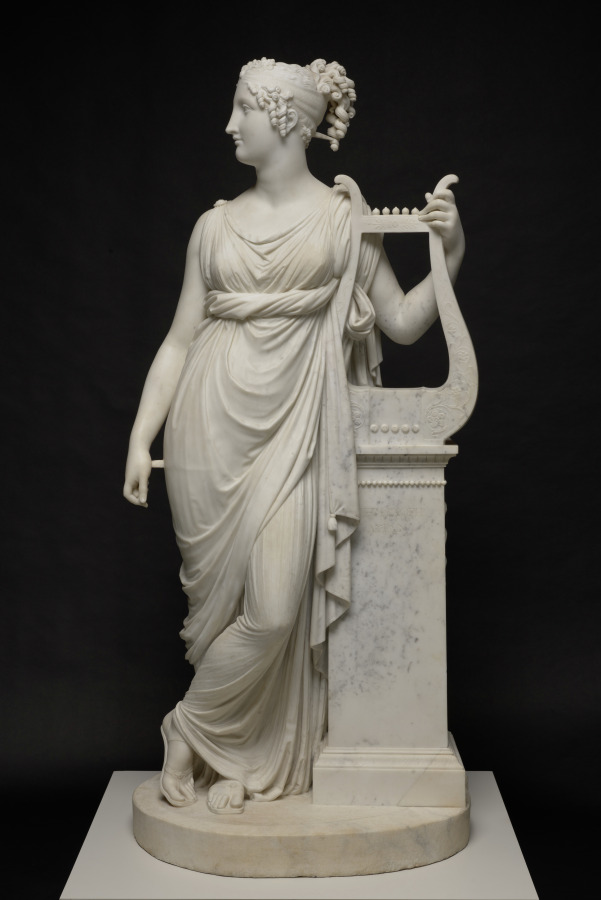
Terpsichore Lyran (Muse of Lyric Poetry)
✓ Authenticity guarantee · ✓ Specialist condition report · ✓ Insured worldwide shipping · ✓ Private-room viewing
In Greek mythology, Terpsichore was one of the nine Muses, or goddesses of creative inspiration. The lyre, the Greek inscription on the short column, and the caduceus (entwined snakes) on the side identify the figure as Terpsichore Lyran, muse of lyric poetry. This sculpture began with a commission from Napoleon's brother, Lucien, for an idealized portrait of his wife, Alexandrine. Antonio Canova made this version for a British aristocrat and exhibited it in 1817 at the Royal Academy in London to great acclaim.
| Artist / Maker | Antonio Canova |
|---|---|
| Date | 1816 |
| Culture / Origin | Italy, 19th century |
| Medium | marble |
| Dimensions | Overall: 177.5 x 78.1 x 61 cm (69 7/8 x 30 3/4 x 24 in.) |
| Department | Modern European Painting and Sculpture |
| Type | Sculpture |
About the Artist
BiographyAntonio Canova (1757–1822) — Italian Neoclassical sculptor (1757–1822).Antonio Canova worked as sculptor, architect, painter, draftsperson and engraver and is associated with Republic of Venice. Their documented life spans the years 1757 to 1822, born in Possagno, died in Venice. Their work is linked to Neoclassicism.Disciplinessculptor, architect, painter, draftsperson, engraverBorn1757, PossagnoDied1822, VeniceNationalityRepublic of VeniceMovementNeoclassicismSources: Wikidata · Wikipedia Full biography →
Provenance & Source
Image & data: Cleveland Museum of Art, CC0 / Public Domain.
Condition
A detailed condition report and high-resolution photography are available from our specialists in advance of the sale.
Shipping & Collection
Fine-art shipping with climate control and full insurance to over 120 countries; collection by appointment.
Buying at Matchless Pieces
Register, verify your identity, and bid online or in a private room. Buyer’s premium and taxes are shown before you confirm.


