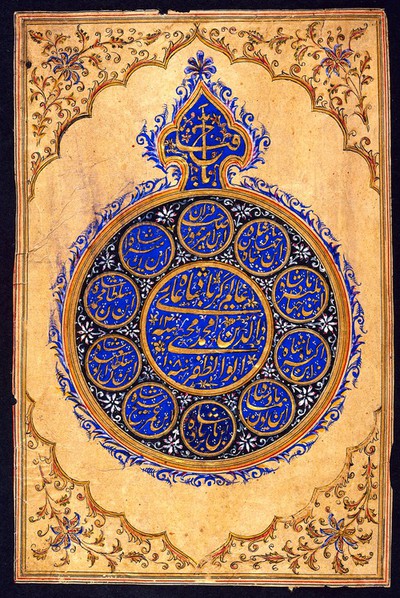
Every major tradition has its founder, and for Ottoman calligraphy that figure is Şeyh Hamdullah. Working in the late fifteenth and early sixteenth centuries, he reinterpreted the classical scripts of the Islamic world and gave Ottoman hat a voice of its own.
Life and Training
Hamdullah was born in Amasya in 1436. His father, a sheikh of the Suhrawardi order, had come from Bukhara. He studied calligraphy with Hayreddin Maraşi, learning the six scripts in the tradition of Yaqut al-Musta’simi, the celebrated thirteenth-century master of Baghdad.
In Amasya he became calligraphy teacher to Prince Bayezid, who served there as governor. When Bayezid II ascended the throne in 1481, he brought Hamdullah to Istanbul. The calligrapher died in 1520.
Key Works
Hamdullah was prolific. His output includes:
- numerous copies of the Qur’an in naskh;
- albums and practice sheets (meşk) combining thuluth and naskh;
- inscriptions for monuments, including the Bayezid II Mosque in Istanbul.
Many of his works are preserved in the Topkapı Palace Museum and the Museum of Turkish and Islamic Arts in Istanbul.
Style and Innovations
According to Ottoman tradition, Bayezid II encouraged Hamdullah to study original works by Yaqut in the palace collection and to develop a style of his own. The result was a refinement of proportions rather than a rupture.
His naskh is clear, balanced and rounded, with even spacing that makes long texts legible and harmonious. His thuluth gained greater fluidity and elegance. Together these qualities produced a script perfectly suited to the copying of the Qur’an, which became the central task of Ottoman calligraphers.
Materials and the Art of Training
Ottoman calligraphy was taught through a demanding apprenticeship, and Hamdullah stood at the head of that system. Students copied a master’s models letter by letter, practised on burnished paper with reed pens (kalem) cut to precise angles, and worked for years before receiving an icazet, the certificate that allowed them to sign their own works.
Ink, paper and tools were themselves objects of expertise. Soot-based ink, carefully sized and polished paper, and the reed pen gave Ottoman script its crisp edges and deep black tone.
Hamdullah’s sons and students carried his method forward, and the master–pupil chain became one of the most important ways in which Ottoman calligraphers defined their authority. Understanding this lineage is key to evaluating any later work in his tradition.
Legacy
Ottoman calligraphers honoured Hamdullah with the title kıbletü’l-küttâb, “the qibla of scribes”. His style dominated for more than a century, until Hafız Osman renewed it in the seventeenth century while still building on his foundations. Chains of teaching certificates (icazet) in Ottoman calligraphy frequently trace their lineage back to him. Read further in A History of Calligraphy (Hat).
How to See and Collect Works of the School
Major works by Şeyh Hamdullah are held in Istanbul museums and leading international collections. On the market, collectors more often find works by later calligraphers in his tradition, Qur’ans and kıta panels. Signature, colophon, paper and illumination all inform attribution, and expert opinion is essential. See related works in our auctions.
Frequently Asked Questions
Who was Şeyh Hamdullah?
Şeyh Hamdullah (1436–1520) was a calligrapher from Amasya, teacher of Sultan Bayezid II, and the founder of the Ottoman school of calligraphy.
What did he change in calligraphy?
Building on the six scripts associated with Yaqut al-Musta’simi, he refined their proportions, especially naskh and thuluth, creating a new Ottoman standard.
Why is he important for collectors?
His naskh became the model for Ottoman Qur’an copying, and calligraphers traced their teaching lineages back to him for centuries.